

The real cost of a migration project nobody needed
Before you replace a system that works, count what the rewrite really costs: months of remapping, retraining, rebuilt integrations — and the surprise in month nine.
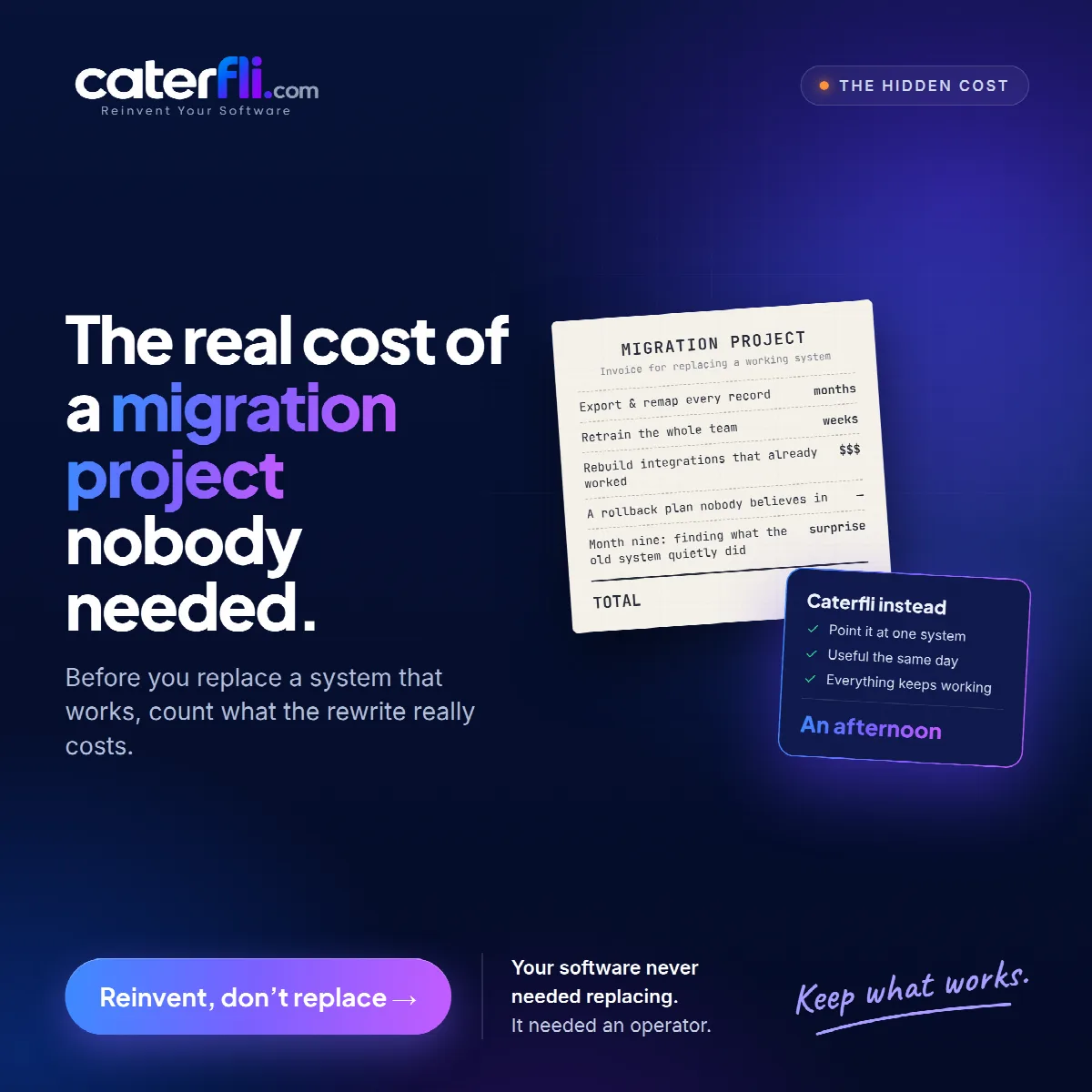
The proposal usually starts with a sentence like "the old system is holding us back". Then a vendor demo, a slide with a timeline, and a number that looks manageable. What the slide does not show is the invoice that arrives line by line over the following year.
It is worth writing that invoice out before signing anything.
The lines nobody prices
Export and remap every record. Months. Every system models the world slightly differently. Customers with two addresses, orders with a status nobody remembers adding, a field that means one thing before 2021 and another after. Each one needs a decision, and the people who can make it are busy running the business.
Retrain the whole team. Weeks. Not just the training sessions, but the slow period afterwards where everything takes twice as long and support answers "I'm not sure where that is now".
Rebuild the integrations that already worked. Real money. The accounting export, the courier webhook, the script someone wrote to sync stock. None of them were broken. All of them have to be rebuilt anyway.
A rollback plan nobody believes in. Every migration has one on paper. Very few teams could actually go back after the first week of new data.
Month nine: finding what the old system quietly did. The surprise. A nightly job that cleaned up duplicate customers. A rule buried in a stored procedure that held back orders over a certain value. Nobody wrote it down because it always just happened, and now it does not.
The total on that invoice is rarely what the slide said.
Ask what is actually wrong
Most of the time, the system being replaced is not failing. It holds the data correctly and does what it was built to do. The real complaint is narrower: people cannot get answers out of it without asking a developer, and they cannot act on it without six clicks in a panel built for someone else.
That is a problem with the *front* of the system, not the system. Replacing the whole thing to fix the front is like moving house because the doorbell is broken.
Operating what you already have
Caterfli takes the other route. Point it at one system: a PostgreSQL or MySQL database, an API with an OpenAPI document, a REST API or an MCP server. Discovery reads what that system can do and turns each capability into a tool. An agent is drafted from what it found, you review it, and your team can ask it questions in web chat, Slack, WhatsApp or Telegram.
Nothing is exported or remapped, because the data stays where it is. Nothing is retrained in the sense a migration means it: the new skill is asking a question in plain language. Every integration keeps working, because nothing they depend on changes. On a database, the platform will not run schema changes at all, and a new connection is read-only until someone decides otherwise.
The rollback plan is genuinely believable this time. Disconnect, and the system is as it was: same schema, same panel, same integrations. Anything an agent changed along the way is listed in the change log, with who asked for it. And the things the old system quietly did keep happening, because the old system is still the one doing them.
None of this makes a replacement wrong when the system really has reached its end. Sometimes it has. But that should be a conclusion you reach after the cheaper option, not before. Reinvent vs replace sets out the comparison in more detail.
An afternoon, not a programme
Connecting a system, reviewing its agent and putting it in front of a few colleagues fits in an afternoon. If it turns out not to help, you have lost an afternoon. If it does, you have avoided a year.
Keep what works. Give it an operator.
0 comments
Sign in to join the discussion.