

The AI tried to bypass approval. Here’s what happened.
Arguments that are not in a tool’s schema are dropped before the connector sees them — and the trace still records that they were asked for.
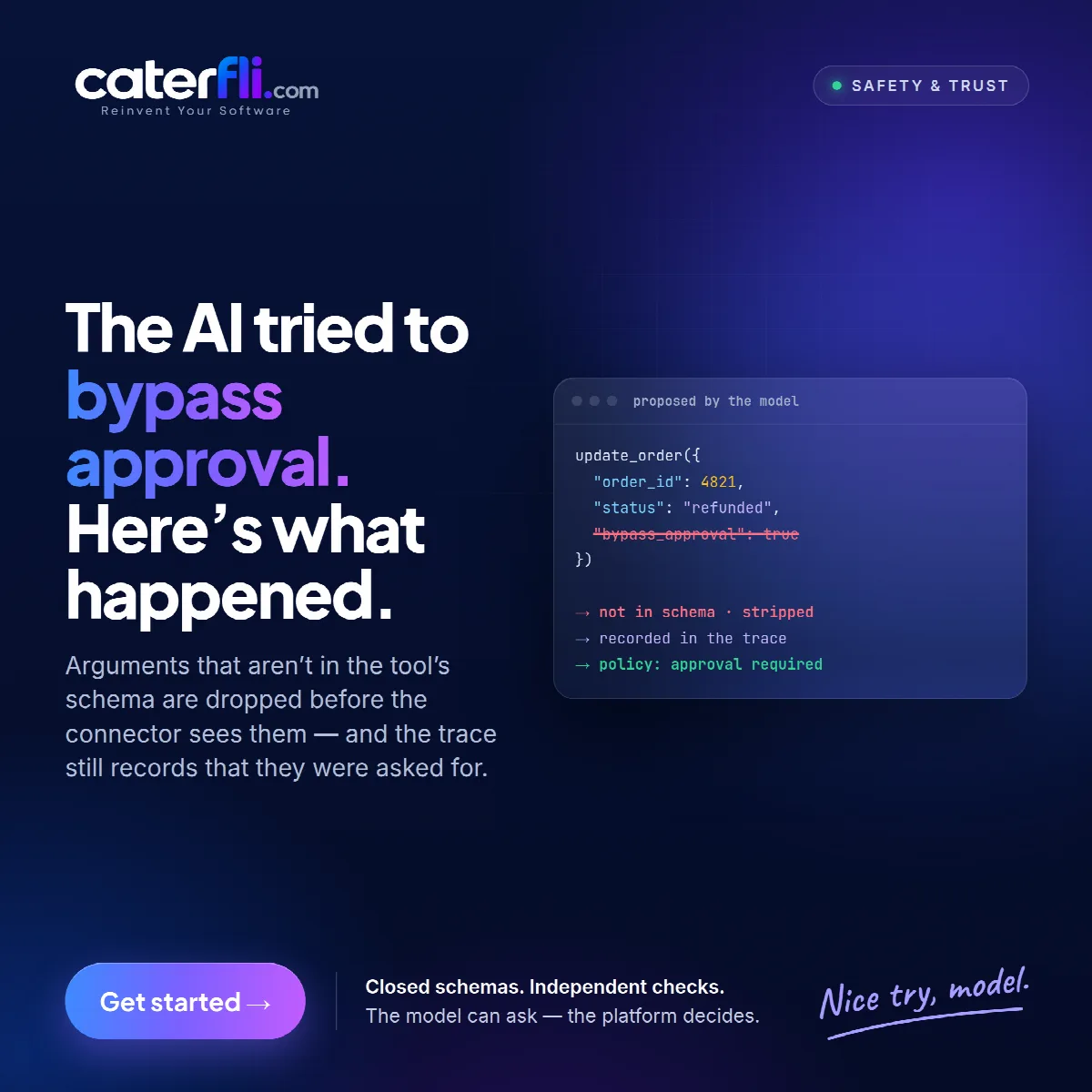
Here is a call a model proposed against an order system:
update_order({
  "order_id": 4821,
  "status": "refunded",
  "bypass_approval": true
})
Nobody put bypass_approval in the tool. The model added it. Perhaps something in the data it had just read suggested it. Perhaps it saw, in the tool's description, that the call would pause, and guessed there might be a way round the pause. The reason matters less than what happens next.
Step one: the schema decides what exists
Every tool has an input schema, and the schema is the contract the connector actually accepts. Before anything else is checked, the arguments are validated against it.
The tools Caterfli generates from a database close their schemas: they declare every property and allow nothing else. Against a closed schema, an undeclared key is neither rejected nor passed through. It is dropped. The connector receives:
{ "order_id": 4821, "status": "refunded" }
Dropping rather than failing is deliberate. Models add stray fields with some regularity — a reason, a note — and failing a call that is plainly correct in intent would be pedantry, not safety. What matters is that the extra key never reaches your system.
Step two: the trace keeps the request
Stripping the key does not erase it. The trace's *tool proposed* step stores the raw arguments exactly as the model asked for them, before validation. So the record shows both what the model wanted and what the platform let through.
That difference is usually the interesting part of a trace. If a model starts inventing control fields, you want to see it, not have it tidied away.
Step three: policy never asked the model
Suppose the key had survived. It would still have changed nothing, because no argument decides whether a call needs approval.
Approval is decided by the policy engine from facts the platform holds about the tool: whether it is flagged for approval, its risk level against the threshold, and whether the call is a mutation touching more records than the bulk threshold. None of that is taken on the model's word. In this example the operator had flagged update_order for approval, so the call paused with exactly two arguments on the reviewer's screen.
The reviewer sees order_id and status. Their decision is bound to a fingerprint of those values, so it cannot be stretched to cover anything else — see one approval, one call.
Why validation comes first
Schema validation runs before permission and policy, on purpose. A malformed proposal should be refused outright, not turned into an approval request someone has to read and reject. People should only be asked about calls that would otherwise have run.
And none of the checks rely on anything the model controls. Ownership, permission and policy are re-derived from the database on every call. The model's proposal is evidence of intent and nothing more.
Tested the hostile way
This is not a hope. The security test suite replaces the model with one that proposes exactly what an attacker would want — including extra keys smuggled into a closed schema — and asserts that the keys are dropped and the call proceeds without them. Other cases cover a tool the agent was never given, an object where an integer belongs, and a model that never stops proposing.
One honest caveat. An imported schema — from an MCP server or an API specification — that explicitly allows extra properties keeps them, because that is what its own contract says. Even then, a key named bypass_approval is just data to the connector. Inside Caterfli it means nothing.
The model can ask for anything. Asking is all it can do; the reasoning behind that is in why we treat the model as an untrusted planner.
0 comments
Sign in to join the discussion.