

“Chat with your database” tools compared: what can the AI actually do?
Reading is easy. Acting safely is the hard part — approvals, permission checks, chat channels and a record of every change.
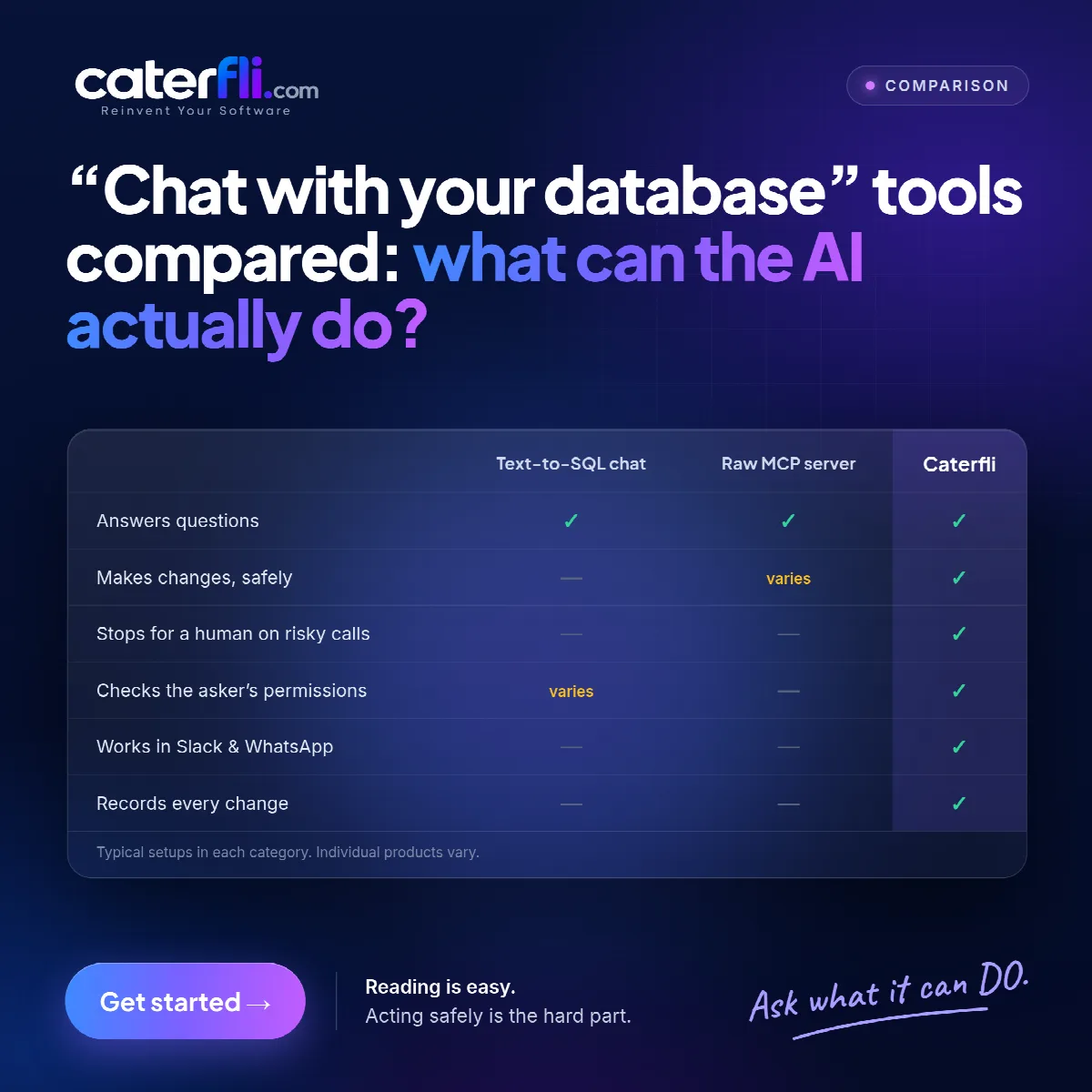
Ask three kinds of tool the same question — "which customers ordered twice this week and have not paid?" — and you will probably get three good answers. Reading is the easy part. The differences show up on the next request: "cancel those orders".
What follows compares three broad categories, as they are typically set up. Individual products vary, sometimes a lot, so treat this as a map of the trade-offs rather than a verdict on anyone in particular.
The three shapes
Text-to-SQL chat. A model is given the schema and writes SQL to answer a question. Usually read-only, often one person's tool, and genuinely good at analysis — the joins and grouping nobody ever built a screen for.
A raw MCP server in front of a database. A server exposes query tools over the Model Context Protocol, and whichever AI client connects can call them. Flexible and quick to stand up. What happens on a write depends on how that server was built and which client is calling it.
An agent platform with an execution layer. This is where Caterfli sits. The model proposes tool calls; a separate layer decides whether each one runs.
Side by side
| Text-to-SQL chat | Raw MCP server | Caterfli | |
|---|---|---|---|
| Answers questions | Yes | Yes | Yes |
| Makes changes, safely | Typically no | Varies | Yes |
| Stops for a human on risky calls | Typically no | Typically no | Yes |
| Checks the asker's permissions | Varies | Typically no | Yes |
| Works in Slack and WhatsApp | Typically no | Typically no | Yes |
| Records every change | Typically no | Typically no | Yes |
What the right-hand column means in practice
It means the model only proposes, and a separate layer decides. Changes go through checked tools, risky calls stop for a person, the asker's own permissions apply, and every change is recorded.
Five safeguards behind the column
Changes are tools, not free-form statements. A database connection is read-only until writes are enabled. When they are, every statement — generated or ad-hoc — passes a structural check first: one statement only, an allow-listed leading keyword, no schema changes anywhere, and no UPDATE or DELETE without a WHERE. Values are always bound parameters.
Risky calls stop. Destructive and high-risk tools wait for a person, and so does a mutation expected to touch more than ten rows. The approval covers that call with those arguments, once.
The person asking is checked, not the agent. Reads need chat access. Anything that changes data needs execute permission, which starts at the manager role. An agent cannot lend someone authority they do not hold.
Channels are doors. Slack, WhatsApp and Telegram reach the same agent through the same checks as web chat, and their allow-lists start empty, meaning nobody.
Every change is written down. The change log names the record, the agent, who asked and, where it applied, who approved — failed attempts included. Separately, the audit log is hash-chained, so rewriting history breaks the chain detectably.
When the other shapes are the right call
If one analyst wants to explore a read replica, text-to-SQL chat may be all they need. If a developer wants their own AI client to inspect a development database, a raw MCP server is a sensible, lightweight choice. Neither is wrong. They are built for one careful person, mostly reading.
The question to put to any of them
The question worth asking any of them is not "can it answer?" They all can. It is: when it is asked to change something, what stands between the model's suggestion and your production data? The longer version of that question, for MCP specifically, is in Caterfli vs a raw Postgres MCP server. If what you need is a new tool rather than a way to operate an existing one, that is a different comparison.
Any of them can read. Compare them on what happens when they write.
0 comments
Sign in to join the discussion.