

When only one person can query the database, everyone waits for them
Holidays, sick days, deep work — every question queues behind one name. Here is how to take the gatekeeper out of the loop without handing out SQL access.
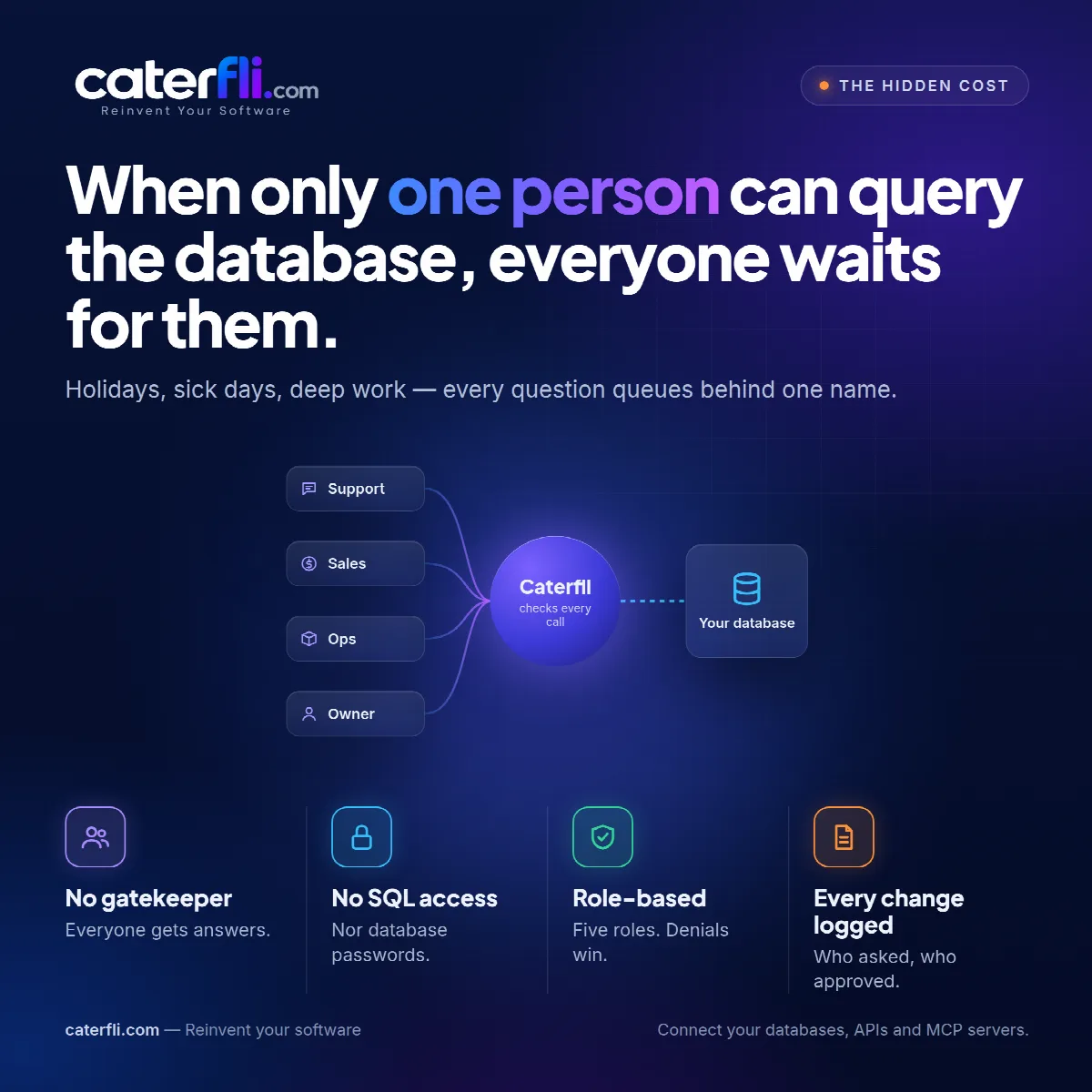
Most businesses past a handful of people have one: the person who can query the database. Sometimes a developer, sometimes the founder who wrote the first version, sometimes an analyst who learnt SQL out of necessity. Support asks them where an order is. Sales asks which accounts went quiet. Ops asks what is stuck. The owner asks how last month compared.
None of these questions is hard. All of them queue behind one name.
The cost is the queue, not the question
When that person is on holiday, the questions wait a week. When they are off sick, a day. When they are in the middle of something that needs concentration, they either break off and lose the afternoon, or the question waits until they surface. Nobody records this as a cost, because it never appears on an invoice. It appears as a customer reply sent tomorrow instead of today.
The obvious fixes each have a catch. Handing out SQL access spreads the risk along with the capability. Building a screen for every question turns one person's queue into a development backlog. Teaching everyone SQL rarely survives a busy month.
Take the gatekeeper out of the loop, not out of the room
Caterfli connects to the database once and discovers what it can do: a list and a count tool for each table, with the real columns baked into each tool's schema. An agent built on those tools sits between your team and the database. Support, sales, ops and the owner each ask it directly, in web chat or in a channel they already use.
What changes is who does the looking up. What does not change is who decides what is allowed. Every call goes through the same checks:
- No SQL access, no passwords. People ask in plain language. The model names tools; the platform makes the call, with credentials decrypted inside the connector and never shown to anyone.
- Role-based, per person. Five roles, from viewer to owner. Reads need chat access; changes need execute permission, which starts at manager. Per-member grants and denials adjust one person without touching a role, and a denial always wins.
- Risky writes wait. Destructive calls, and changes expected to touch more than ten rows, stop for someone who can approve them.
- Every change logged. The change log records the record, the agent, who asked and, where it applied, who approved.
What the gatekeeper does instead
Usually, they set it up — because they are the one who knows the schema. After that, their job shifts from answering questions to deciding the occasional approval and reading a trace when an answer looks wrong.
Setting the boundaries
They choose which tables are visible, which rows a connection may reach, and whether writes are enabled at all. They create a database account with the least privilege it needs, since the platform's restrictions are a second line of defence rather than a substitute for one.
Reviewing the agent before anyone uses it
Then they review the generated agent before anyone else can reach it. Its instructions describe the system, its tables and how they relate; destructive tools arrive enabled but gated. It can be tested from the agent page while it is still a draft, and nobody else can use it until it is deployed.
A better use of the one person who knows the data
That is a better use of the one person who understands the data. The ops version of this story is in give ops database answers without SQL access, and the record-keeping side in every change your AI makes, written down.
Knowing the schema should not make someone a bottleneck. It should make them the person who sets the boundaries.
0 comments
Sign in to join the discussion.