

Why we treat the model as an untrusted planner
An LLM can propose deleting every customer. Here is what happens between that suggestion and anything actually running.
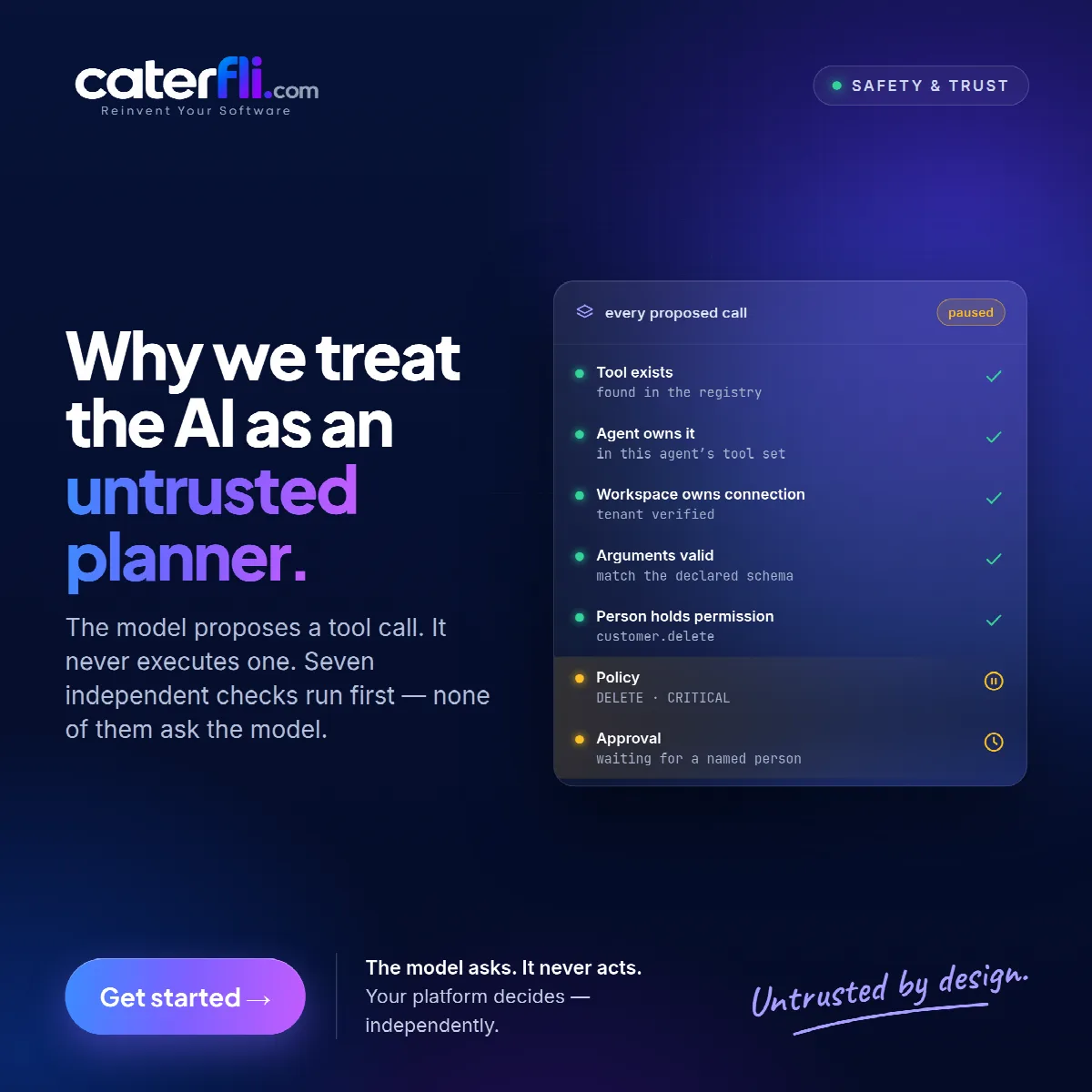
An agent platform has one question at its centre, and everything else is downstream of the answer: **what happens between the model saying "call delete_customer" and that call actually running?**
Our answer is that the model is a planner, and an untrusted one.
A suggestion is not an instruction
A language model can emit any tool name with any arguments. It can be talked into it by a hostile document it was asked to summarise. It can arrive there on its own, confidently and wrongly. Neither case is unusual enough to design around as an exception.
So a proposed call is treated as what it is: a request from an untrusted source. Before anything happens, the platform verifies — independently, without consulting the model again — that:
- the tool exists, and this agent is allowed to use it
- your workspace owns the underlying connection
- the acting user holds the required permission
- the arguments validate against the tool's own input schema
- policy permits this operation at this risk level
- a human has approved, when approval is required
Why the prompt is not a security control
We write a careful system prompt. It makes the model behave better, and it makes its answers more useful. It is not what stops a deletion.
Telling a model "never delete anything" is theatre when the deletion is blocked anyway. What genuinely helps is telling it *when a call will pause for a human*, because a model that knows this tends to confirm intent first — which is exactly the behaviour you want.
An approval authorises one call
When a destructive operation pauses, the reviewer sees the tool and the exact arguments. Approving it does not unlock the tool, or the agent, or the rest of the conversation. It authorises **that call, with those arguments**, once.
The binding is a fingerprint of the arguments taken at the moment the question was asked. If the agent re-plans and produces something slightly different, the approval no longer matches, and the run stops again.
That distinction is the whole point. "A human approved something like this" is not a control. "A human approved exactly this" is.
Credentials never enter the conversation
The model sees tool names and argument schemas. It never sees the credential that reaches your system — not in a prompt, not in a response, not in a log line. Secrets are decrypted by the connector at the moment of the call and held only for its duration.
This is not a matter of trusting one AI provider more than another. It is that there is no version of "your database password went to a third party" that we are comfortable with.
0 comments
Sign in to join the discussion.