

Per-person permissions. Denials win.
Five roles plus per-member grants and denials. An agent can never lend someone a power they do not hold.
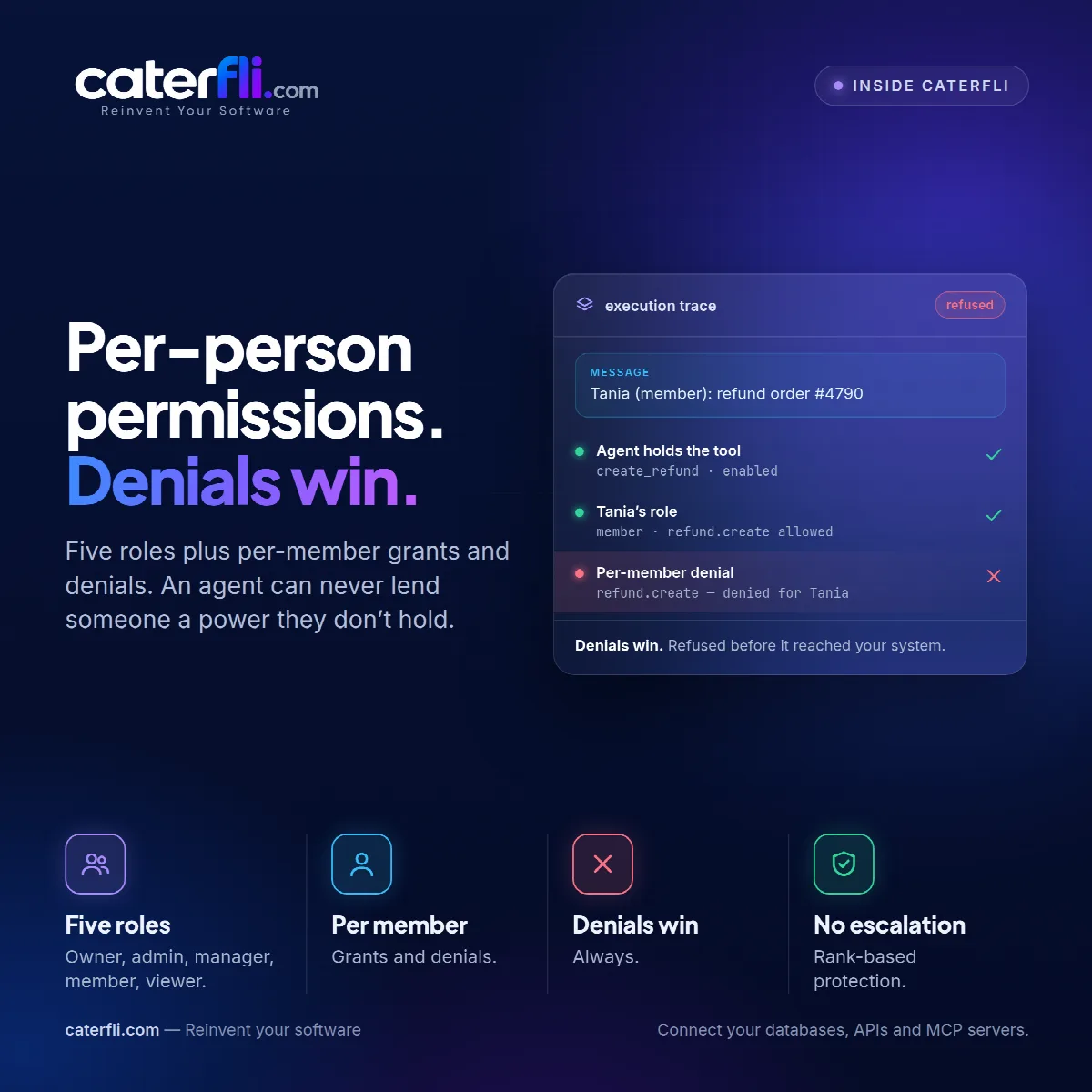
Tania could issue refunds on Monday. By Tuesday the business has decided she should not, for a reason that has nothing to do with her job title: the refund policy is under review, or she is covering a different desk this week. Nobody wants to invent a new role for one person and one week.
That is what per-member grants and denials are for.
Five roles to start from
Every workspace begins with five roles, ranked from the top:
| Role | In short |
|---|---|
| Owner | Everything, including deletion and ownership transfer |
| Admin | Everything except ownership transfer and deletion |
| Manager | Builds and operates agents, manages connections, approves high-risk actions |
| Member | Day-to-day work: chat, running agents, reports |
| Viewer | Read-only: agents, executions, reports and the approval queue |
The line people notice first sits inside the member role. A tool that only reads needs chat.use, which a member has. A tool that changes anything needs tool.execute, which starts at manager. So a member can ask how many orders came in today, then ask the agent to update one of them and be refused — same person, same agent, same conversation.
Grants and denials on top
Roles are a starting point, not the last word. A membership can carry its own extra grants and its own denials, and the effective set is worked out the same way every time:
role permissions + per-member grants − per-member denials
Denials are subtracted last, so they always win. If the same permission appears in both lists, the contradiction resolves to denied, because that is the safe reading. Taking one capability away from one person never requires cloning a role, and every change to a member's grants or denials is written to the audit log.
What the trace shows
Back to Tania. Her role is manager, so it carries tool.execute. Her membership carries a denial of tool.execute. She asks the agent to refund order #4790.
The trace reads in order. The agent holds create_refund and it is enabled. The arguments match the schema. Then the permission check looks at Tania — not at the agent — finds the denial, and refuses:
You do not have permission to run create operations (tool.execute required).
The connector is never called. The refusal is recorded in the trace, and the model is told why, so it can say so plainly rather than invent a success on the next turn.
The agent cannot lend authority
This is the property the design leans on. An agent acts on behalf of the person using it. It has no authority of its own to hand out. A viewer talking to an agent that holds create_customer still cannot create a customer, and Tania, with her denial, cannot refund through an agent that is perfectly able to refund.
That is what makes it safe to give an agent a powerful tool: the tool is only as reachable as the person asking. How those refusals read in practice is covered in the most useful line in a trace.
Nobody climbs the ladder from below
Roles carry a rank, and the rank stops escalation. You cannot assign a role at or above your own. You cannot change the role of somebody who outranks you — demoting them included, since that is the same escalation taking the long way round. The owner role is not assignable at all; it moves only through ownership transfer.
Approvals follow the same logic. Seeing the queue is a viewer permission. Deciding on it is approval.decide, which starts at manager — and a denial of approval.decide takes it from one manager without touching anyone else.
Permissions belong to people, not to whichever agent they happen to be talking to. The rest of the model is on the security page.
0 comments
Sign in to join the discussion.