

Caterfli vs a raw Postgres MCP server: what you get beyond query access
Query access is the easy part. Approvals on risky changes, per-person permissions and a record of every change are what make it safe to point at production.
Getting a model to read a Postgres database is now an afternoon's work. Run a self-hosted MCP server, give it a connection string, point an AI client at it, and you can ask about last week's orders in plain English.
The trouble starts when the question is no longer "can it read the data" but "can the support team use this against production". That is a different problem, and query access is the easy part of it.
By a *raw* server we mean a typical self-hosted one with no extra tooling around it: the model, the server, the credential. What it can do is whatever that credential allows, and every safeguard beyond that is yours to build.
What sits on top
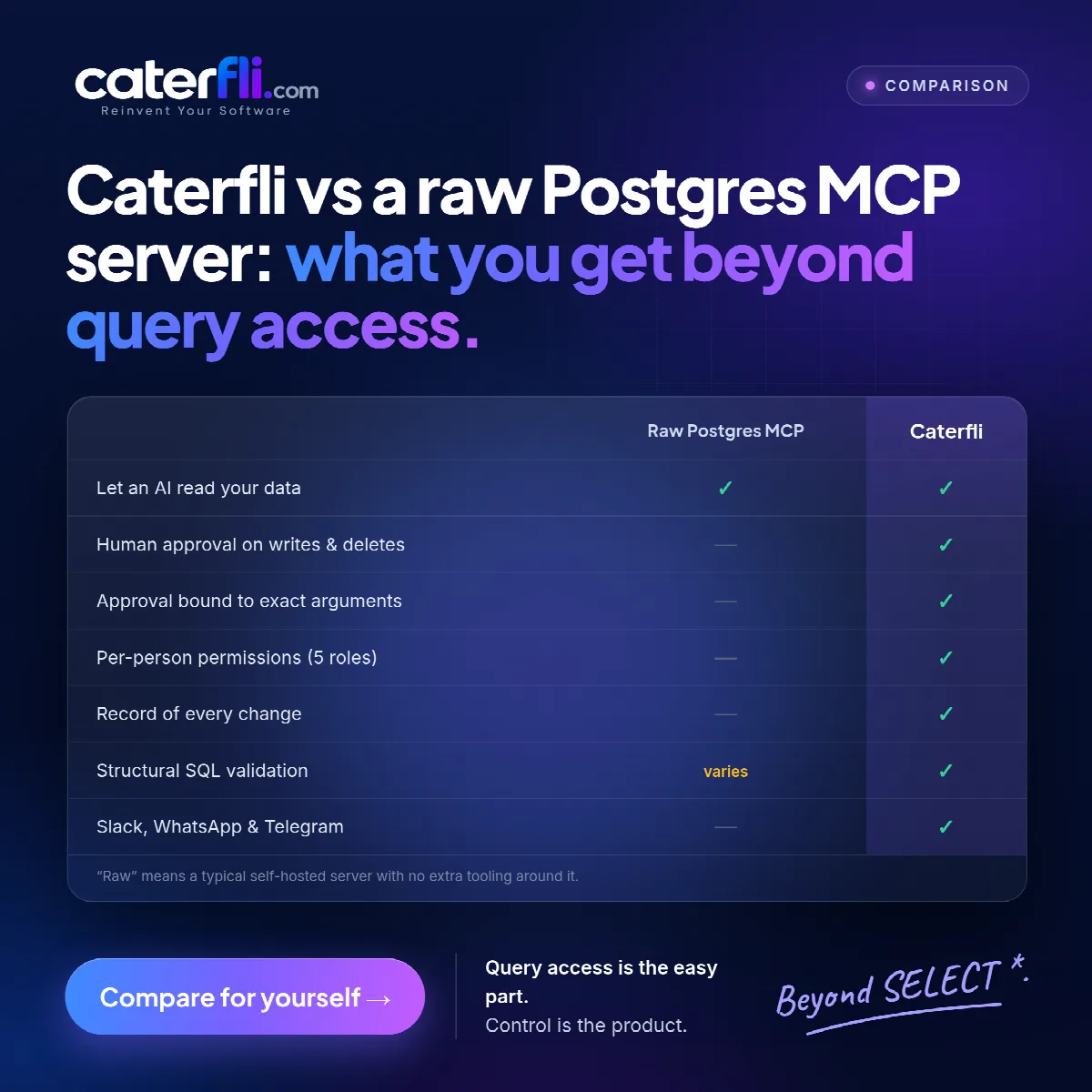
Both let an AI read your data. Caterfli adds human approval on writes, bound to the exact arguments, per-person permissions, a record of every change, structural SQL validation, and Slack, WhatsApp and Telegram.
Side by side
| Capability | Raw Postgres MCP | Caterfli |
|---|---|---|
| Let an AI read your data | Yes | Yes |
| Human approval on writes and deletes | No | Yes |
| Approval bound to exact arguments | No | Yes |
| Per-person permissions (five roles) | No | Yes |
| Record of every change | No | Yes |
| Structural SQL validation | Varies | Yes |
| Slack, WhatsApp and Telegram | No | Yes |
Each capability in turn
Approval on writes. Destructive tools arrive enabled but gated. A call stops when the tool requires approval, when its risk is high enough, or when a change is expected to touch more than ten rows. Nothing runs until a person decides.
Bound to exact arguments. The decision is tied to a SHA-256 fingerprint of what the reviewer saw. Approving a delete for customer 100 cannot be stretched to customer 1. One approval. One call. Exact arguments. goes through it.
Per-person permissions. With a shared credential, everyone using the client has the same power. Here the agent acts on behalf of a person, and that person's role decides. Reading needs chat.use; changing anything needs tool.execute, which starts at manager. A viewer talking to an agent that can create customers still cannot create a customer.
A record of every change. Every record an agent created, updated or deleted is listed with the agent, the person who asked and, where needed, the person who approved. Failed attempts are listed too.
Structural SQL validation. Some servers restrict what they will run; some do not. Every statement here, generated or ad hoc, is checked before it is sent: one statement only, an allow-listed leading keyword, no schema changes anywhere, and no UPDATE or DELETE without a WHERE. Values are always bound parameters, and a statement timeout is set at the database.
Chat channels. The same agent, with the same checks, reachable from Slack, WhatsApp and Telegram, where the people asking the questions already are.
Things that are easy to miss
Discovery writes a read tool and a count tool for each table you select, with the real column list baked into each tool's schema, so the model can only filter on columns that exist. New connections are read-only, and ad-hoc SQL is off until someone turns it on. Credentials are decrypted inside the connector at the moment of the call and never appear in a prompt or a trace.
None of this replaces database permissions. Give the account the least it needs. The platform's checks are a second line of defence, not a substitute for the first.
You do not have to choose
This is not raw MCP against no MCP. Caterfli connects to MCP servers too, and their tools land in the same registry, with risk levels, approval gates and the same checks as everything else. Unrecognised verbs are treated as actions rather than reads, so a guess errs towards stopping for a person. If you already run an MCP server, connect it and keep it.
Query access answers questions. Control is what lets you point it at production.
0 comments
Sign in to join the discussion.