

The answer is already in your database. Your support team is still waiting for it.
A customer asks where their order is. Today that takes a developer and most of a morning. It could take under a minute.
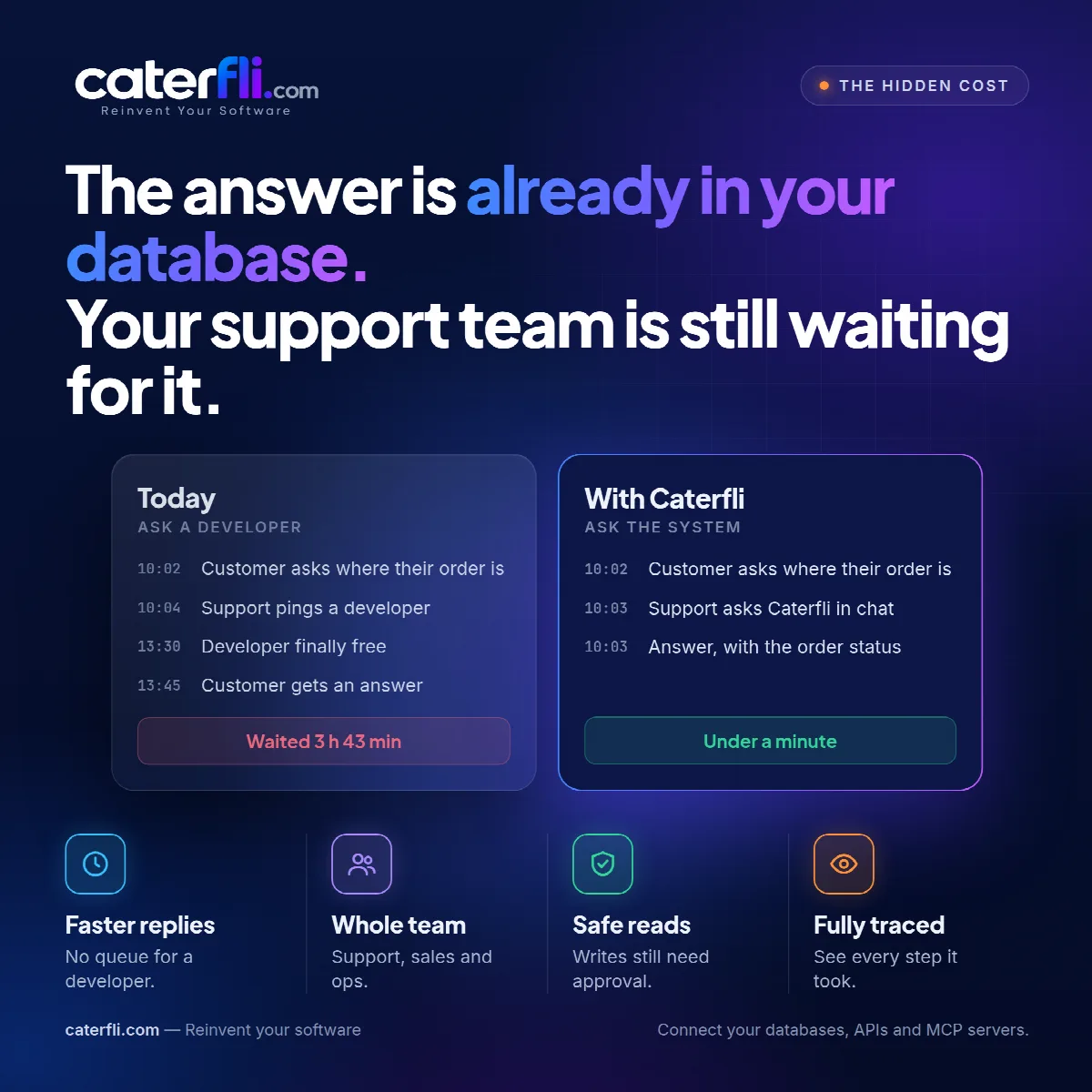
At 10:02 a customer emails to ask where their order is. At 10:04 someone in support pings a developer. The developer is in the middle of something, as developers usually are, and gets to it at 13:30. At 13:45 the customer has an answer.
That is an illustration rather than a measurement, but most teams will recognise the shape. The answer took fifteen minutes to fetch and three and a half hours to queue for. Nobody in that chain did anything wrong. The order status was sitting in the database the whole time. The only person who could reach it was busy.
The wait is the cost
It is tempting to count this in developer minutes, and those add up. But the larger cost is the wait itself. The customer waits. The support agent holds a ticket open with nothing to say. The developer loses the thread of whatever they were doing, and that costs more than the fifteen minutes the lookup took.
None of it is a support problem. It is an access problem. The information exists; the person who needs it cannot ask for it directly.
The same question, asked of the system
Here is the same morning with Caterfli connected to the order database:
- 10:02 — the customer asks where their order is.
- 10:03 — support asks the agent in chat: "where is order #4821?"
- 10:03 — the answer comes back with the order's status, in a sentence.
No ticket to a developer, no admin panel, no SQL. The support agent asks in plain language, the agent looks the order up, and the reply is written for the person reading it, not for whoever wired up the connection. It does not mention tables or queries. It answers the question that was asked.
Why this is safe to hand to support
The reasonable worry is that "support can ask the database anything" sounds like "support can do anything to the database". It is not: reading and changing are separated by role, writes still need approval, and every step is traced.
Roles, approvals and traces
Reading and changing are separated by role. Looking something up needs chat.use, which a member has. Anything that changes a record needs tool.execute, which starts at manager. A support agent can ask about an order and be refused when they ask the agent to edit it: same person, same agent, same conversation.
Writes still need approval. Destructive and high-risk calls stop for a person to decide, and so do changes expected to touch more than ten records. A new database connection is read-only until someone switches writes on.
Every step is traced. Each run records what the agent proposed, what was checked and what ran, including the calls that were refused. If an answer looks wrong, the trace shows where it came from.
Beyond the support desk
It is the whole team, not just support. Sales asking whether a customer has paid, ops asking which orders are stuck in packing: these are the same kind of question, and they queue behind the same developer today. Let support look up orders without opening the admin panel walks through the support case in more detail.
Nothing to rebuild
The database stays as it is. Caterfli reads the schema, turns each table you select into a read tool and a count tool, and drafts an agent from what it found. You review the agent before anyone talks to it. The admin panel, the integrations and the code your developers maintain are untouched.
The answer was always in the database. The only thing missing was a way for the person who needed it to ask.
0 comments
Sign in to join the discussion.