

Your admin panel works fine. So why does everyone still ask a developer?
Because the answer takes six clicks, three filters and knowing where to look. The panel is not broken — it was just never built for questions.
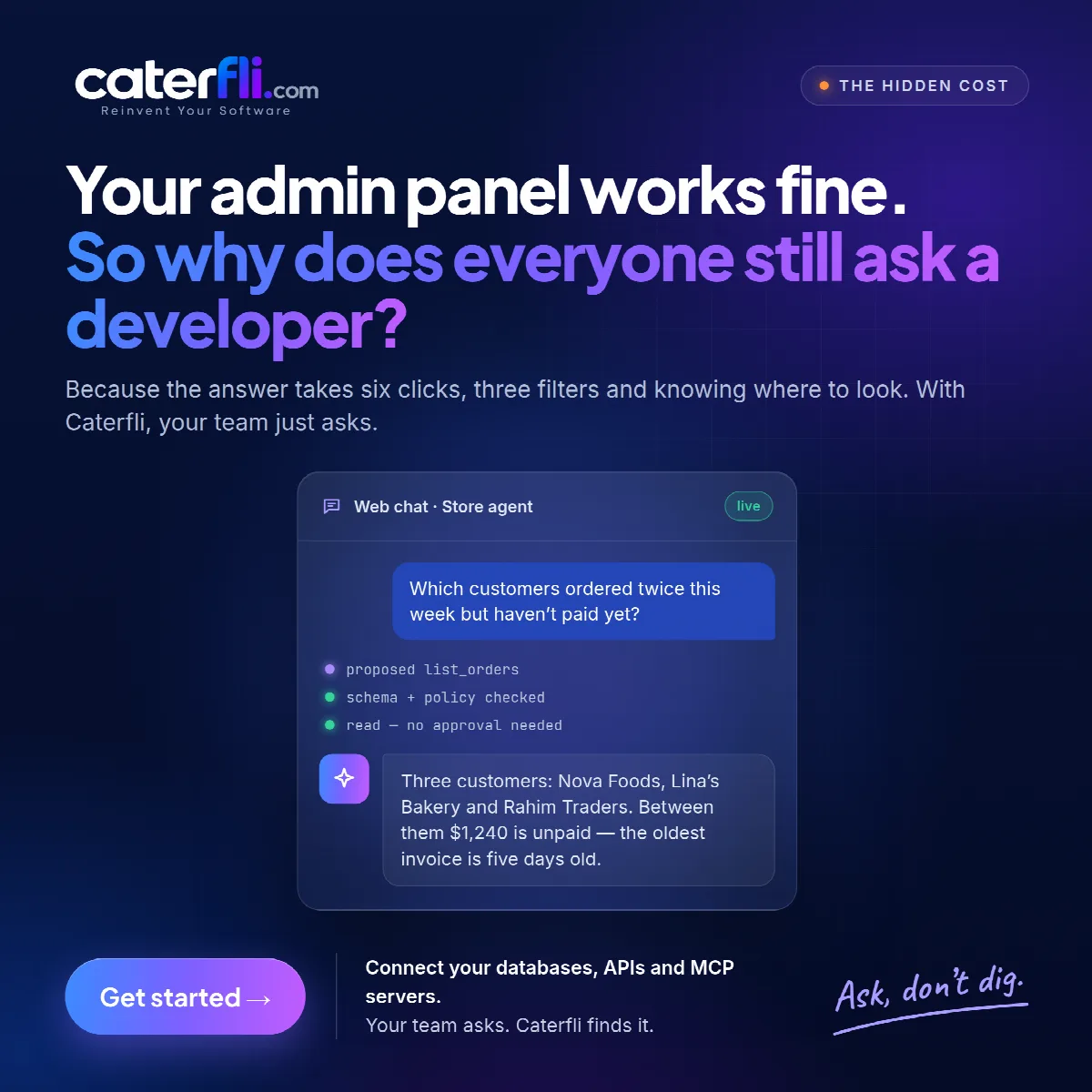
Nothing is wrong with your admin panel. It lists orders, opens them, edits them and saves them. It has done that reliably for years. And yet the question "which customers ordered twice this week but haven't paid yet?" still ends up in a developer's direct messages.
Built for records, asked about patterns
An admin panel is designed around one record at a time. Find the order, open it, change a field, save. That is what the people who built it were asked for, and it does it well.
Questions are a different shape. "Ordered twice this week but haven't paid" crosses records: it means filtering orders by date, grouping them by customer, counting, then checking payment status, which may well live somewhere else. In the panel that is six clicks, three filters and knowing which screen holds the payment column. Most people give up at the second filter and ask someone who can write the query.
So the panel is not broken. It was never built for questions, and every question it cannot answer turns into one of two things: a message to a developer, or a request for a new screen. The first costs someone's focus. The second costs a sprint, and produces a screen that answers exactly one question.
Ask, don't dig
With Caterfli connected to the same database, the question is typed as it is thought:
Which customers ordered twice this week but haven't paid yet?
In this example the agent proposes list_orders. The platform checks the arguments against the tool's schema and runs it through policy. It is a read, so no approval is needed. The answer comes back as a sentence:
Three customers: Nova Foods, Lina's Bakery and Rahim Traders. Between them $1,240 is unpaid — the oldest invoice is five days old.
A few things make that answer trustworthy rather than merely fluent.
- The agent works from your real schema. Discovery bakes each table's actual column list into its tools, so the model is choosing among columns that exist rather than guessing at names.
- The arithmetic does not have to come from the model. The built-in toolkit includes a calculator and date tools, because a model doing sums is wrong in the worst way: confidently, and looking exactly like an answer.
- Failures come back as failures. If a call is refused or the connection is down, the model is told, so it says it could not reach the data instead of inventing a total.
- Every step is in the trace. Which tool was proposed, with which arguments, and what came back. If a number looks wrong, you can see where it came from.
For questions no generated tool covers — joins across several tables, unusual groupings — a database connection can also offer an ad-hoc SQL tool. It is off by default, and every statement it runs is checked first: one statement, an allow-listed leading keyword, no schema changes.
Keep the panel
None of this asks you to retire anything. The panel stays the right place to edit an order with care and a full view of the record. Caterfli adds a way to ask about many records at once, from web chat, Slack, WhatsApp or Telegram, without anyone needing to know the schema.
The panel answers "show me this". The agent answers "find me these". Most teams need both, and the cost of routing the second kind through one developer is usually larger than it looks.
0 comments
Sign in to join the discussion.