

Add an AI assistant to every client system you’ve built
One workspace per client. Each client’s data stays in its own workspace, with isolation that fails closed.
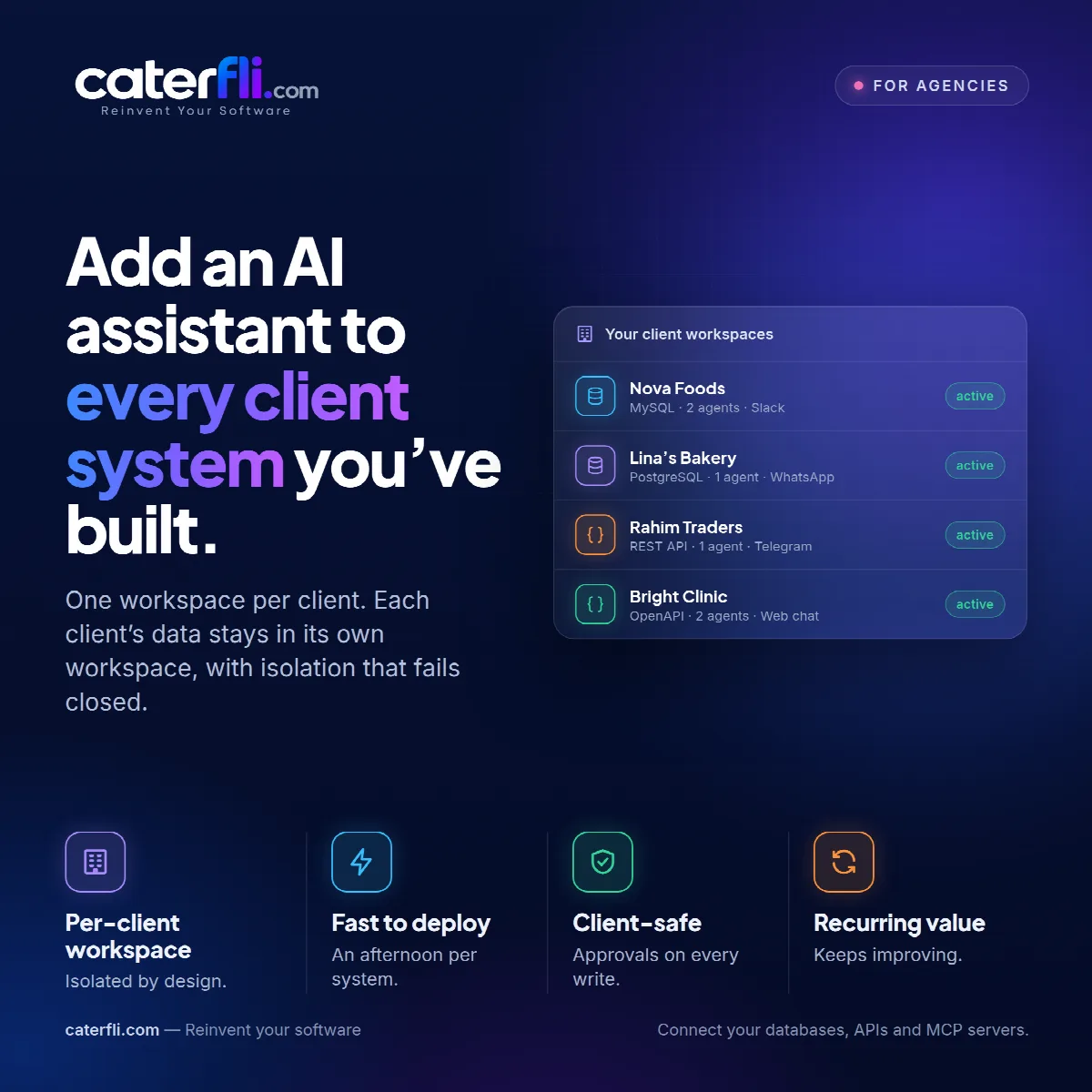
If you build software for clients, you probably have a list like this. A MySQL store for one. A PostgreSQL ordering system for a bakery. A REST API for a trading company. An OpenAPI-described booking service for a clinic. Each one works. Each one has an admin panel you built, and each client still messages you when they want an answer the panel does not give.
You know these systems better than anyone. That makes you the obvious person to put an assistant on top of them.
One workspace per client
The unit in Caterfli is the workspace. Agents, connections, channels, approvals, reports, the audit log and the change log all belong to one, and you can create as many as you need from the same login. One per client is the natural shape:
- Nova Foods — MySQL, two agents, answering in Slack.
- Lina's Bakery — PostgreSQL, one agent, on WhatsApp.
- Rahim Traders — a REST API, one agent, on Telegram.
- Bright Clinic — an OpenAPI service, two agents, in web chat.
Those are illustrations, but the mix is the point. Each client gets the connection that fits the system you built them and the channel their staff already use, and nothing has to match across the list.
Isolation that fails closed
Keeping one client's data away from another is not a convention here. The workspace is the tenant boundary, enforced in four separate places. Every query on tenant data is scoped to the active workspace, and with no workspace resolved the scope returns nothing rather than everything. New records are assigned to the active workspace automatically. Saving a record that belongs to another workspace throws an error and is logged. And a URL carrying another workspace's id is resolved inside the current one, so it finds nothing before any controller runs.
Each of these is tested, including an owner of one workspace trying to act on a member of another. The design aim is that a mistake produces an empty page, not a leak.
Safe to hand over
The question a client will ask is what happens if the assistant gets something wrong. The answer is the same for every system you connect.
Destructive tools arrive enabled but gated. Anything high-risk, or any change expected to touch more than ten records, stops for a person. The approval covers that one call, with the exact arguments the reviewer saw. Database connections start read-only. Every change an agent makes is listed with who asked and who approved. Credentials are encrypted per secret and never enter a prompt.
You decide who in the client's team can do what. Five roles, from viewer to owner, with reading and changing on different sides of the line. The client's staff can ask; whether they can change anything is up to you and them.
Fast to set up, worth keeping
Connecting a system, generating its agent from what discovery found, reviewing it and adding a channel is an afternoon per system, not a project. That is the one-off part.
The ongoing part is where the value sits. Re-running discovery when you change the schema. Tuning instructions as you see real questions in the traces. Adding a scheduled report the owner reads every morning. Adding a second agent when ops wants one of their own. That is work you are already the best placed person to do, and it continues for as long as the system does. A new recurring revenue line for freelancers who build admin panels looks at how that can be packaged.
You built the systems. Giving each client someone to talk to inside them is a short step from there.
0 comments
Sign in to join the discussion.